Autumn is the perfect season for fleeing in terror from a homicidal maniac in Don't Look Back! from Black Site Studios.
Craig and I played the first scenario (in the first edition rulebook). It is a very straightforward "run across the board without getting killed" affair. Two factors made the scenario easier than intended: (1) we used a 3x3 rather than 4x4 play area and (2) I forgot the scenario rule that characters take 1 Terror Token per turn after leaving the starting quadrant. Nonetheless, the game was great fun with plenty of tense moments.
Alice, Denise, Holden, and Max were hanging out at the soda counter of the diner. Four stereotypical teenagers looking for something exciting to do on a Friday night. Max had scored some beer. Alice was going on and on about ouija boards. Holden's van had a full tank of gas. And Denise suggested partying in the abandoned house where those murders happened years ago.
Denise: You're not afraid are you, tough guy?
Max: N-no way! It's just ... that old place is a real dump.
Holden:Trespassing. Stupid idea, if you ask me.
Alice:C'mon, it'll be so cool. We could contact the beyond!
In a booth across the dining room, Deputy Sandy listened to the kids plan their evening from behind a copy of the local newspaper. The front page headline read "Town Remembers Unsolved Murders Ten Year Later". She folded the paper and watched the kids pile into Holden's van, shaking her head.
12 AM.
The kids were staring at each other over a tree stump, faces lit by the lantern Max snatched up when they bolted out of the abandoned house moments before.
Max: We should never have messed with that ouija board!
Alice: I thought ... it was just a game ...
Denise: Why won't any of these people answer their doors?
Holden: We have to get back to the van. It's the only way.
The kids needed to get from the top left corner of the play area to the bottom right, where they had parked the van in the driveway of the abandoned house.
In DLB, a character must make a Jump Scare Test if they pass within 2 inches of area terrain during their movement. We counted houses, bushes, and cars as area terrain for this purpose.
Holden jumped the fence of the side yard where the kids started to get into the road, away from any area terrain. Ironically, he triggered a Jump Scare when passing within 2 inches behind the blue car and triggered all the Fright Tokens to move toward him.
As a result, the other kids tried moving behind the house to avoid the Fright Tokens. Alice, Denise, and Max ended up moving pretty slowly because of Tap On The Shoulder results on the Jump Scare table. This result pulls the closest character into B2B with the active character, including pulling them back from where they just moved.
On Turn 3 (of 12), the Killer showed up. We randomly generated a Killer with damage reduction, regeneration, and a skill debuff aura. He appeared on a Fright Token in front of the abandoned house, appropriately enough. But his M.O. had him teleport within 6 inches of the most players, which ended up being between the houses across the street:
The first in a series of lucky rolls resulted in the Killer failing to hit his would-be victim Denise, who slipped away after Alice distracted him. Holden proceeded down the street and managed to hit the Killer with his shotgun through the picket fence after Denise scampered over.
Before Max could run away, a Jump Scare put the Killer right behind him. But this was also fortunate as it meant the Killer could not attack that turn.
On Max's next activation, he Stumbled Away without tripping and used a Cell Phone he had found on the first turn to summon Deputy Sandy between him and the Killer. The deputy apparently decided to keep a close eye on these youngsters tonight after overhearing them talking in the diner earlier.
The Killer dispatched Sandy immediately. Fortunately, none of the kids witnessed her grisly end and so avoided taking Terror Tokens. The kids sprinted down the street toward the van and, hopefully, safety. Alice investigated a Point of Interest on the front porch of one of the houses and found an Assault Rifle. But fighting this particular Killer did not feel like an effective plan. Better to flee.
Denise made it to the driveway of the abandoned house, while Holden covered them with his shotgun. Before Alice and Max could get there, the Killer appeared again but, on another lucky roll, did not make it B2B with Denise. Alice and Holden both shot at the Killer with little effect. Denise used her Cell Phone to summon ... Deputy Sandy!
In classic horror movie fashion, a character we thought was dead returned at the crucial and most dramatic moment. The Killer, again, immediately dispatched our brave intercessor (this time causing everyone but Max to take Terror Tokens) but Denise was able to use her other two actions to pass an Awareness Test to end the game.
With gunshots and screams echoing through the darkness and Denise frantically waving her hands on the side of the highway, it's no surprise that someone pulled off the road to investigate. Caught in the beams of the headlights, a huge masked figure stood over a prone and motionless body. The figure turned toward the car menacingly before taking a hesitant step backward, spinning on its heal, and sprinting off into the shadows faster than anything natural.
Having really enjoyed my first adventure using the Nightwatch rules, the only thing for it was to keep experimenting. How easy would it be to adapt Nightwatch to exploring a dungeon environment? Only one way to find out: send more hobbits into peril!
The main challenge would be adjusting the movement rules given the relatively cramped interior spaces involved. Per the book, the default movement rate in Nightwatch is seven inches (a six inch front-to-back or "leap frog" move) that is halved for difficult terrain. In my estimation, this would be way too generous for indoor adventuring. The solution was pretty obvious, based on my experience with "crawler" board games and our own "Dungeons Deep & Caverns Old" miniatures game: zone movement. So once I had the basic layout of the dungeon set up, I just needed to carve it up into zones.
I'll reference this map throughout the report below but for now suffice it to say that our adventurous Halflings would spend their first free move to enter via E1 into zone 1-A. Green rectangles represent open passages while red ones designate passages that are permanently or temporarily blocked.
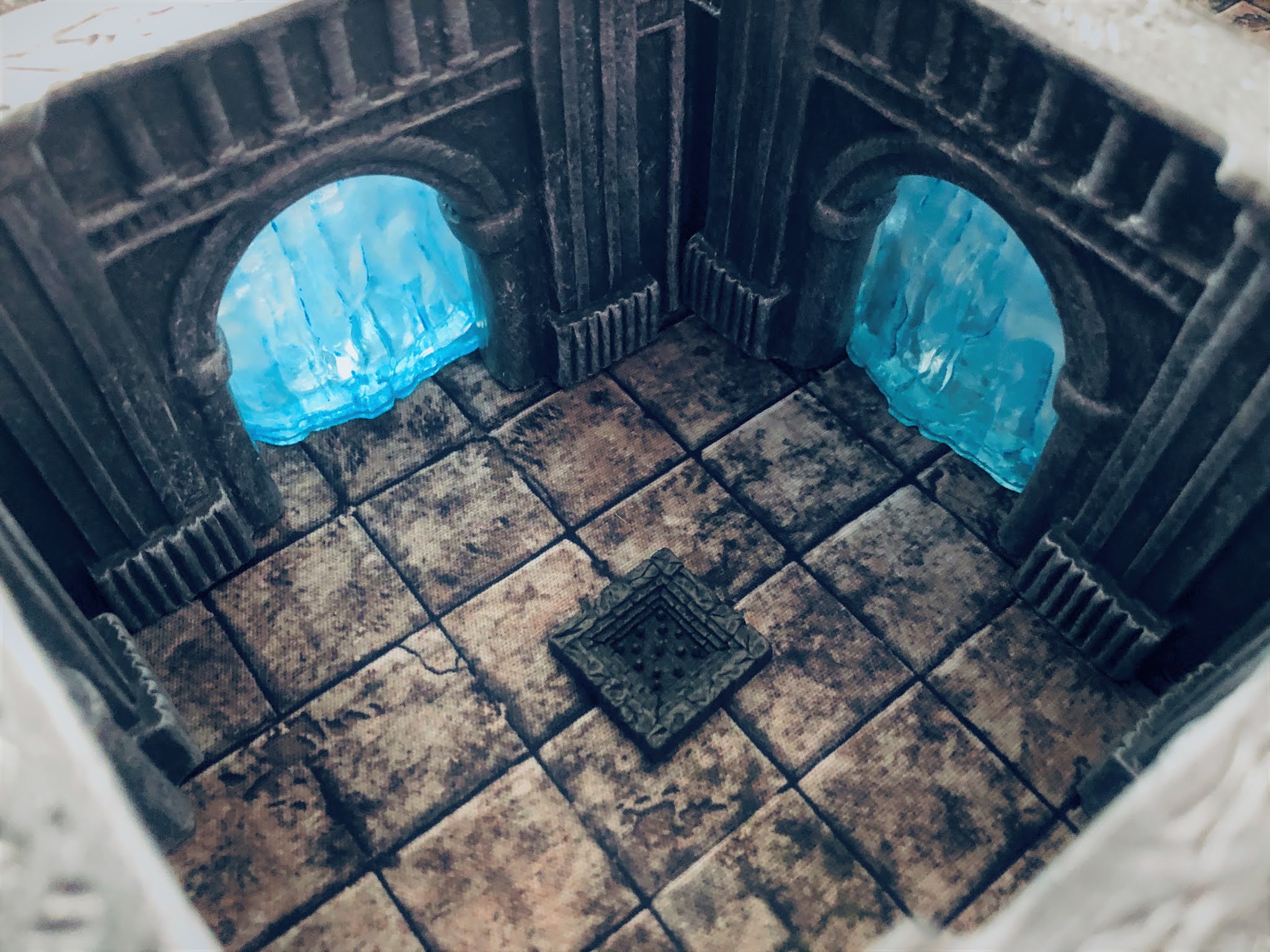
The next challenge was handling indoor ranged attacks. I constructed this dungeon using pre-painted terrain available from Urbanmatz; more precisely, their Gothic Walls. This set has pieces with open passages as well as semi-obstructed ones per the photo below.
I decided that neither PCs nor Monsters could move through these passages but could shoot through them at a -2 penalty. Several Skeletons armed with bows started in-play, in rooms where they could be shot or from which they could shoot out but not be reached for melee combat.
The next issue was figuring out how tough to make the Skeletons. I started out by using the Vermin rules (free move + 1d6 activation dice pool) but found that made the bonemen too chumpy. So I settled on giving them a 2d8 dicepool and allowed them to spend 1d8 for a free move. The result was them being pretty dangerous but also kind of slow, which felt right for the dungeoneering experience.
Room 2
The Halflings started by exploring Room 2, the barracks. To get to the investigation point in zone 2-C, they would have to navigate either or both of zones 2-A and/or 2-B. As you can see on the map above, I have those zones marked with a special border, indicating that they are dangerous terrain. In the picture above, you can see that there are traps on the floor.
Mechanically, this is represented by the PCs needing to use an action to make a check to avoid the traps when moving into (but not out of) the zones. The PCs need not make this check, but if they don't (or if they did and failed), they would take a wound. This further slowed down the pace of exploration and lent the small space a somewhat "larger" (cinematically speaking) sense.
Having made it past the traps, the Halflings found a tattered journal in a chest next to the bunks indicating that the nearby Chapel-Infirmary (Room 5) had been desecrated and the corpses of former guards turned into necromantic batteries powering magical barriers preventing exploration deeper into the dungeon.
Room 3
Two of the three magical barriers were blocking the north and east passages of the central intersection at Room 3, which as you can see from the map and the photo above was also trapped. The Halflings had little reason to back to Room 2 but nevertheless the trap in Room 3 would make navigating the dungeon difficult throughout the entire session.
In a small pouch tucked away with the journal, the Halflings found a charm that, according to the anonymous author, could be used to purify one of the defiled corpses and thereby dissolve the associated barrier. But navigating the Chapel-Infirmary, would be precarious because it was likewise full of traps. This time, poison gas! Fortunately, the journal also explained that an antidote for the poison could be found hidden away somewhere in the cluttered stores (Room 4).
Room 4
Even despite Room 4 being one of the smaller physical spaces in the dungeon, I decided to carve it into three zones to simulate the difficulty of navigating all the junk. (Note that D3 is permanently blocked by cumbersome supplies.) I had a mechanic kinda-sorta in mind for how the Halflings could try to find the poison antidote among the crates and barrels and chests but I did not end up using it because, well, let's just continue the story for now. On to the Chapel-Infirmary.
Room 5
Room 5, like Room 4, is carved up into quite a lot of zones. I designed this area for a lot of player interaction and wanted to make sure that it was plenty dangerous but not overly lethal. Instead of taking a wound for failing the check to move carefully (or just failing to even attempt to move carefully), the unlucky (or incautious) PC would take a poison token that would inflict a -1 penalty on any roll of their largest remaining die in their dice pool.
So, for example, a PC who had already taken a single wound also took a poison token, they would roll their d8 at -1. If they took an additional poison token, they would roll both their d8 and d6 at -1. Worst of all, a third poison token at this point would eliminate their free move! This ended up being pretty tense and, well, let's just say I probably should have spent some time searching for the antidote.
I should also note that all this time, during the Darkness phase, a single Skeleton had a 5 in 6 chance of entering the dungeon at E2. So in addition to all of these traps, the Halflings were also constantly fighting the undead (who I decided could not be harmed by the traps). But at this point, things were still looking pretty good.
In order to lower one of the magic barriers, the Halfling equipped with the charm would need to perform an interact action at one of the three investigation points in zones 5-B, 5-C, or 5-D. I decided that it didn't matter which one at this point: upon a successful interact action, the barrier blocking D1 would dissolve. The issue was, which barrier would be dissolved the second time the Halflings tried the ritual? I decided to randomize it between D2 and E4.
Also, at this point, Skeletons were now appearing at either E2 or E3. Rooms 8 and 9 were of course still blocked off by D2. The idea there was, if the PCs dissolved the barrier blocking D2, a whole slew of bonemen could march out at them together ... or not, depending on how the dice rolled when it came to randomly assigning new Skeletons every Darkness phase. As it turned out, quite a few of them started to build up at 8-A:
Room 8
But that wasn't a problem just yet. Dissolving the barrier blocking D1 opened up Rooms 6 and 7. The first was just a hallway with another magical barrier blocking E4. But Room 7 was the Officer's Quarters, where the Halflings could find another charm to purge one of the remaining two necromantic barriers in the Chapel-Infirmary. No matter which investigation point they chose, however, the outcome was a fifty-fifty chance between D2 and E4.
Room 7
As it turned out, the Halflings dissolved the barrier blocking E4 and behind it stood the Terror! I somewhat foolishly did not adjust the Terror's rules so it had a free move plus its usual 3d10 dice pool. At this point, I decided if the Halflings could defeat the Terror they would "win." They were in fairly good condition, with just a poison token each. So they bravely, or foolhardily, rushed to meet it; and it did likewise.
The Final Confrontation
Unlike normal Terrors per the rules, I also decided that this one, the Terror of this particular dungeon, would have three rather than one wound. The Halflings fought bravely but, worn down by constant combat with the roving bonemen and the poison gas, they could not land the final blow before meeting their own fates.
Alas!
It's worth noting that had the barrier blocking D2 been dissolved it would not only have unleashed the Skeletons waiting at zone 8-A but also opened up the final room, the Commissary.
Room 9
The Commissary is pretty spacious but I left it as one zone. The idea was that in order to move into base to base for melee combat, Skeletons and PCs starting their turn inside of Room 9 would still have to make a move action. But they could enter the room directly in melee range with an enemy already in that room. The other idea was that the PCs could make a search action in the Commissary at any time to obtain a Health Potion. This ended up being sorely needed in the final analysis, but of course Room 9 was never accessible.
I didn't spend a lot of time spinning a tight story about why the Halflings were exploring this dungeon, what had happened there, or exactly how the whole thing should work. The point was to quickly get something put together to just keep playing around with the Nightwatch rules. In conclusion, Nightwatch again proves that it is flexible enough to be used for fantasy adventuring beyond the theme laid out in the book without much pre-planning. This whole dungeon fit snugly onto a 2x2 mat but one could easily imagine a much more extensive structure with all kinds of more complicated and dangerous encounters.
Ostensibly, Nightwatch is a game about seasoned monster hunters sworn to chase down and ultimately rid the world of some terrible evil. And between these grim hunters and their quarry are wave upon wave of relentless minions. Cool, but not necessarily what I'm looking for in a miniatures game. Rather, I want a miniatures game that emulates the feel of classic D&D adventuring without a dedicated DM player. Nightwatch seemed promising, in that it's a solo/co-op game where the players control a small group of adventurers defined by their classes.
But I had one major concern: designer Patrick Todoroff writes, "you'll need need several dozen monster types of various kinds." First off, I just don't want to have to buy, assemble, and paint up that many miniatures for what, for my purposes, should be an "ultra skirmish" game (i.e., very low figure count). But more importantly, squaring off against dozens of monsters just doesn't feel like D&D to me. YMMV. So could I get the results I wanted from Nightwatch without the "several dozen" enemy miniatures? I set out to find out armed with a paltry nine plastic Skeleton figures from Wargames Atlantic. Against them stood four brave plastic Halfling figures, made by the same company.
The other concern was more broad: Is Nightwatch flexible enough to handle my particular vision of D&D? This boils down to an approach where "calls" matter more than rules. That is, where the game supplies tools to support adjudicating whatever crazy things might come up during the course of play rather than forcing play into predetermined categories of interactions. Would my brave Halflings be able to do anything beyond move, ranged attack, melee attack, rinse, repeat? What if they wanted to try to swim in a river, for example? Again, Nightwatch seemed promising because Todoroff clarifies straightaway that "Nightwatch is a toolbox, not an extensive, pre-packaged, comprehensive system."
OK so challenge accepted! Where to begin? If it was a "theatre of the mind RPG," I'd need a story hook. But for a miniatures game, at least in my approach, story begins with terrain. And this seemed like a wonderful excuse to dig deep into my collection of ready-to-play terrain items from Gale Force 9, Wizkids, and Monster Fight Club. So, prior to game night, I fiddled around with a couple of 2x2-foot neoprene mats from Battle Systems and a wealth of scenery.
A Perilous Quest
A story began to emerge as I tinkered away. Wishing to seize control of a strategic bridge, a necromancer attacked the surrounding community and devised a typically macabre means of garrisoning the ruins: by way of corrupting energies, symbolized by fell crystals growing out of toxic pools, sorcerous standing stones erected nearby in the forest would continuously reanimate undead warriors to hold the bridge. Consulting an erudite scholar of magic, our heroes learn that shards of these crystals must be sheared off and used at the standing stones in a ritual to exorcise their horrid power, thus liberating the bridge.
In game terms, the objectives were to (a) get to the green stars (the crystals) and use an Interact action to collect a shard from each and then (b) carry the shards to the blue stars (the standing stones) and perform the ritual with another successful Interact action. Skeletons would be defending the ruins of the town and any that were slain in the process of exploring the ruins would be redeployed at one of the two standing stones, returning to further harry our heroes. The Halflings started at the red circle at the river ford.
Here is what the Halflings ended up facing on game night, on the ruined town side of the play area:
Oh man look at those bonemen go!
Note that there are "investigate tokens" placed on various elements of scatter terrain, indicating that these are searchable. In base contact with the crates and barrels, a player character ("PC" - I'm using the standard RPG term rather than Todoroff's theme-specific term "Hunter") could make an Interact action to search them for useful common items: roll 1d10 and on a 1-9 it would be one of the common single-use scrolls, potions, or "grenadoes" a character can start the session with and on a 10 it would be a single-use Token, a kind of magical curio. Common items take up a "belt slot" of which a PC only has two, whereas Tokens do not take up a belt slot.
Also of importance: to get to a crystal for the purpose of breaking off a shard, the PCs would have to wade through toxic sludge. In addition to being difficult terrain (halving movement), any character who ended their turn in the sludge gained a Poison Counter. Three of these translated into a Wound, of which PCs only have four. And for each wound taken, a PC loses one of three potential activations during his turn.
Meanwhile, here is the comparatively desolate forest portion of the play area, where the necromancers vile servants erected the magical standing stones:
Spooky Times Ahead
We randomly determined that the river flowed slowly from the town side toward the forest side. Apart from the ford, it counted as difficult terrain plus any figure that failed a movement check when attempting to cross it would be carried two inches down river. None of this is from Todoroff's rulebook; it's just the sort of "D&Desque" call that I like to flavor a scenario. It would become pretty important later on ...
Reolus the Ranger Found 1SP.
Getting into the action of our session requires a little bit of description of Nightwatch's mechanics. All PCs have a dice pool consisting of 1d6, 1d8, and 1d10. Any action, apart from a free move, requires selecting one of these dice and rolling a 4+, which is obviously easier on a d10 than a d6. So if you want to move in addition to your free move, you need to roll one a 4+ on one of the PC's dice. If you don't, that PC doesn't move. If you want to hit an enemy in melee combat, you need to roll a 4+ on one of the PC's dice. If you don't, that PC's attack fails to hit. And so forth. If it's something you really need to work, use a die with more faces.
Once you roll a die, it is spent for this turn regardless of whether you roll 4+ on it or not. And when a PC has no more dice to roll, their turn is over. So each unwounded PC ends up with a free move and potentially three more actions per turn. Of course, if you roll really poorly you might only get the free move, but in my view something is better than nothing. The entire dice pool is ready to use again on the next player phase, called the Pact Phase.
Noble Scudamor Surrounded!
But before the PCs go again, the monsters get to act in the Darkness Phase. The most basic monsters are called Vermin and they have a free move just like the player characters but they only have a single d6 for their dice pool. I decided the Skeletons would be represented by the next most powerful category of monsters: Horde figures with a free move and a 2d8 dice pool. Just like PCs, monsters need to roll 4+ on dice to attack successfully or do anything else. If they successfully hit a PC, or if a PC successfully hits them, they get to make a Dodge/Defense (DD) save: roll a 4+ and you don't take a wound.
Almost all monsters in Nightwatch are vanquished upon taking a single wound. They roll their DD check on their usual die type (d6 for Vermin, d8 for Horde, etc.). PC's check DD on a d6 but the result can be modified by the type of armor they are wearing. Heavier armor can give you a +1 to your DD check but also cost you 1" of movement, and vice versa for lighter armor. When the attacker outnumbers the target, as in the picture above, the target tests DD at -1 for each opponent beyond the first. So PCs definitely do NOT want to get swarmed!
As mentioned above, PCs only have four wounds. But the bigger problem is a PC loses a die from his pool for every wound he has taken, starting with the d10, then the d8, and finally the d6, until a PC who has taken three wounds only has his free move left. Mercifully, you can spend your free move to Imbibe a potion in your possession ... like a, um, Health Potion.
What's in the boxxxx?
Having retrieved two of three crystals shards necessary to perform the ritual, our Halfling Heroes were making good progress into the ruined town. They suffered a few wounds which they shrugged off by way of imbibing Healing Potions they had wisely brought along, freeing up belt slots. So should they hurry on to the final toxic pool or search the ruins for other helpful items to fill those empty slots? After defeating this Skeleton spearman, plucky Priamus tried his luck and found a Smoke Grenade.
They went thattaway!
On the other side of the King's Road, reanimated Skeleton warriors so lately despatched by our intrepid Halflings returned from the dreaded forest to exterminate the intruders. The Skeletons had little enough trouble, with their free moves and 2d8 action dice pool, finding their way back to the action. So far, I did not feel like I really needed dozens of monster figures to have a dangerous adventure with the Nightwatch rules. These nine Skeletons were giving the Halflings enough trouble. Correction, eight skeletons. The Ninth had yet to reveal himself in his dark glory ...
Bumbling Bonebois
Priamus used his recently-looted Smoke Grenade to confuse the skeletal advance. Per the published rules, a Smoke Grenade can be thrown 12 inches and will not scatter on a successful ranged attack check. Targets, whether friend or foe, caught in the resulting large blast template (failing to find a definition in the rules, we decided on 6 inches) blindly wander around until they are out of the smoke, using a d10 to randomize the direction of movement and distance traveled (result halved). Here, we made our own call: if a Skeleton stumbled into scenery, it would fall prone and have to use a free move or movement check to stand back up before moving farther.
It just made sense that barely sentient undead would be clumsy. Whether Skeletons with empty eye sockets could really be confused by vision impairing smoke is, of course, metaphysically debatable. Similarly, would Skeletons be effected by a Stun Grenade? How do they draw LOS? The point is, these are all opportunities to make calls during the course of play just as a DM would when running a session of old school D&D. Whatever you decide will probably not "break" Nightwatch because of its inherent flexibility. The system is sound enough to let the players choose whatever seems most exciting or interesting.
And boy would things get interesting soon enough!
Check out the index card "character sheets."
Eventually, the Halflings made it to the second toxic pool and found it guarded by a more capable servant of the necromancer. The next highest level of monster is called a Terror and has a free move plus a 3d10 dice pool. Our heroes decided discretion was the better part of valour and retreated from it after retrieving the shard, but the Terror easily caught up with fleeing Priamus.
Rather than face down the Terror, he jumped into the river and attempted to swim downstream. But failed his check and bumped his head on the stone bridge. He made a check to resist being knocked out ... and failed again! He made a third check to see if he started to drown (i.e., took a wound) as he bobbed unconsciously downstream. Whew, a lucky success. His heavy pack must have weighted him to float face-up.
Here again, there was nothing in Todoroff's rules to indicate whether a PC could do this much less what should happen if the attempt went poorly. We just used our best judgment and found that Nightwatch's fundamental structure easily allowed us to adjudicate the results on the fly. As to what happened to poor Priamus? On the other side of the bridge, a Skeleton fished him out of the river and he had to use dice from his pool to recover consciousness. Again, not in the rules but the rules are so open and sturdy that it was a cinch to seamlessly carry on the adventure even when faced with such unexpected circumstances.
Once Priamus so quixotically escaped the Terror's icy grasp, Adelgrim the Ranger (just barely seen in the top right corner of the picture above) decided to sing an arrow into the imposing skeletal serjant. A hit! And to the player controlling Adelgrim, an unwelcome surprise. He did not know that the Terror, like Horde figures, only had one wound. And where did the fiend reanimate?
SH-T!
Right at the sorcerous standing stone where Reolus and Scudamor had hurried off to commence the ritual of exorcism! Adelgrim, carrying the third of the three shards, soon joined them and the Terror could not stop them from completing the ritual on the first standing stone. But he summoned his silent minions to march through the claustrophobic forest and punish our heroes. Scudamor fell fighting off the undead but not before throwing the shard in his possession to Adelgrim. Reolus likewise prepared to meet his doom, passing off his shard to his fellow Ranger.
The Fall of Reolus
Surrounded (-3 to DD rolls), Reolus could not withstand the Terror and his minions, who carved up the unfortunate Ranger rather than breaking off immediately to pursue Adelgrim. Meanwhile, Priamus in soaking chainmail hastened from the river after defeating the undead warrior who had pulled him out, in a desperate attempt to reach the final standing stone. So much for the merry chase our Halfling Heroes had led the undead warriors on back in the ruins! It was now or never and at the second stone, Adelgrim was fumbling badly through the ritual as the Terror finally caught up with him.
There may come a day when the courage of Halflings fails ...
Priamus the Sodden made it, just in time to retrieve the final shard from Adelgrim and complete the exorcism! The necromantic fires of hatred where quenched in the Skeletons and they crumbled, bones and weaponry alike clattering amid the stony forest underbrush. Our heroes had liberated the bridge from the evil sorcerer's servants but at dear cost. Scudamor and Reolus likewise lay still among the fallen autumn leaves. There would be no further adventure for those brave companions. But to stand up against those who so carelessly underestimate them, a Halfling warrior would gladly pay his life's blood!
So did Nightwatch work for what I wanted? You bet it did.
Todoroff is absolutely correct to characterize Nightwatch as a toolbox. Veteran miniatures gamers might object, "What's the big deal? Any ruleset can support scenario-specific rules." The trouble is, scenario-specific rules are still rules in the sense that you have to invent them beforehand and they need to harmonize with all the other rules at play. What I wanted, and got, out of Nightwatch was a structure that allowed me to make calls rather than apply rules.
To illustrate the difference, let me point out that I could not find any rules for stealth in the book. So what can be done about it? Well, using the approach of scenario-specific rules, I would need to invent a stealth system and playtest it to see if it broke the structure of the game. I was recently brainstorming such a mechanic with a friend where a figure would be considered to have "stealth status" until it failed some kind of push-your-luck roll, which would emulate the tension of needing to be swift but wanting to remain unseen. Maybe we could implement that in Nightwatch.
But what if it just came up during the course of play and we hadn't thought of it before hand (like willfully plunging into a river). With Nightwatch, it would be so simple to make a call, based on the particular circumstances of that moment in the game, that a PC could remain undetected by monsters that hadn't already seen him simply by taking a -1 penalty to his movement check. Or maybe instead of a penalty, his movement while trying to remain undetected would simply be halved. Or rather than either of those things, he would need to make an additional role from his dice pool after making a successful movement check: you moved the full distance but it turns out it wasn't stealthy!
With Nightwatch, I could use any or all of these simple solutions in the course of the same game. Which I picked would just depend on what was going on at that instant, what made sense for that moment rather than what would make sense prospectively for all hypothetical moments. The latter is the domain of rules instead of calls. Calls are for this instance, rules are universal. This is what I mean when I say that Nightwatch, for me, captures the old school D&D feeling I want.
And I definitely did not really need dozens of monster miniatures on hand to get the experience I wanted. Now if you want to play the specific theme Todoroff presents for Nightwatch, maybe you do need that many miniatures. I did not. Just how many Skeletons did the Halfling Heroes defeat? We stopped counting at twelve. That's right, a dozen. Just by recycling Skeleton casualties back into play, we ended up fighting at least twenty one enemies using only nine miniatures to represent them. The gradation between Vermin, Horde, and Terror really helped there.
I also considered allowing the Skeletons to use the same Weapon Skills as the PCs. I didn't go into it above but fighting with a certain weapon allows a PC to perform special tricks. For example, Scudamor was armed with a single shortsword. Therefore, he could make a melee check against a Skeleton that would push the boneman back an inch rather than possibly killing it, avoiding the Skeleton's DD check and freeing him up from having to take a free attack from the Skeleton if he had disengaged from base contact. What if monsters could also use these tricks?
We tried it with the Terror, who had a hoplon and kopis, meaning that on a successful d10 melee attack check he could also make a free d6 shield bash attack check. It made him that much more frightening, although was it necessary considering his 3d10 dice pool? And whether that's too in-the-weeds for minions at large is a question for another day. It's simply another thing to try with this toolbox called Nightwatch. Another simple experiment would be to give a minion monster multiple wounds.
I have some reservations about Nightwatch, of course. For example, what would differentiate an Orc raider from a Skeleton warrior? Even old school D&D has enough granularity to make those enemies meaningfully different. Maybe not so, with Nightwatch. But that's another challenge I'm willing to accept after this excellent first impression.
For another hobbyist's take on Nightwatch, played more "as-intended," please check out this video from Dice Tales on YouTube:
I ran a demo game of Advanced Song of Blades and Heroes (hereinafter ASoBH) for my friend Doug this past weekend using some of his gorgeously painted models: Doug took on 3 Blightkings from Games Workshop's Age of Sigmar range against my six elves from GW's Hobbit range - four Mirkwood palace guards and two Mirkwood rangers. It was a fairly straightforward fight, this being a demo game.
now that's a clear cut situation with the promise of comedy - tell your friends!
Ancient trees gone rotten overnight, putrid carcasses of deer littering the seasonal trails, and the nauseating reek of decay hanging heavy amid leaf and branch ... something evil was defiling the forest - something a pack of Elven scouts had little trouble tracking down. The disease-ridden monstrosities made their lair in an old ruin. There were only three: one carrying a ponderous shield, another waving around a hoary axe in one bloated claw and a rusted sword in the other, and the third wielding an enormous scythe. The Elves choked back rage and contempt and prepared to close in ...
oh man look at those knife ears go
I won initiative and began by firing with my rangers in the woods at C on the map above while two teams of shield and spear moved up to B. Doug sent two of his Blightkings to flank the archers and the third, the dual-wielding figure, south to carve up one of the sword/shield teams. Because I gave the Blightkings the Lumbering trait, they couldn't "grab" the Elven rangers - who led them on a merry chase through most of the game. Meanwhile, the dual-wielder almost immediately cut down an Elf spearman. I moved the others in to support the surviving shield Elf, confident that Doug would keep after my rangers with his other two Blightkings.
The Blightkings all had Heavy Armor and Tough. Taking one down was an uphill battle even for three Elves. By the end of the first scrum it was also literally uphill:
new cocktail - pox on the rocks
I gave the Elves Q3 C3 and the Blightkings Q4 C4. We did not use the Leadership trait at all so Doug got a bit frustrated that his Blightkings gave up Initiative so ... willingly? (lazy bastards!) and seemed reluctant at best to take reactions. But they also had the Big trait, meaning I was only breaking even with them when I was fighting them three-to-one! And even when I had them knocked prone, their armor got them out of quite a few tight spots.
The dual-wielding Blightking eventually went down and I moved my surviving Elves up cautiously to intercept the next target. My plan had been to lure one of the remaining Blightkings to the center while "kiting" the other away with my rangers.
gonna need some freaking back up here!
But the rangers' long bows had proven so absurdly ineffective against Nurgle's favored layabouts that Doug was now content to pretty much ignore them. He also closed in with his shield-bearer, who I feared the most - Block combined with the other "survivability" traits I gave the Blightkings would make him the greatest challenge. My elves could not even manage to put a single wound on the scythe-wielder by the time the shield-bearer was in position. Things were looking grim indeed.
But then the clouds parted - I knocked the scythe-wielder prone with one Elf and then tripled Doug's combat roll with a power blow from another Elf! The scythe-wielder lost all of his three wounds in one mighty thwack (swish?) of flashing Elven steel!
get him out of my sight
Oh but wait - we had forgotten his Heavy Armor trait, which saved him from the Gruesome Kill I so desperately needed. Instead, the scythe-wielder simply took the first of three wounds ... truly, Papa Nurgle was pleased with his servants' earlier lethargy! Basking in the sordid favor of his patron, the shield-bearer proceeded to nonchalantly murder my remaining Elf spearman.
blessings of Nurgle upon you, friend
Not to be outdone, the scythe-wielder cranked back his Huge Weapon for a power blow and eviscerated one of the remaining Elven warriors in a hideous shower of gore.
the gruesome killee becomes the gruesome killer
The final warrior failed his Morale test on all three dice - seeing the tide turn so viciously seemed to have broken his mind. He is probably still hiding somewhere in the forest, rocking back and forth while sobbing.
By the way, the two Elven rangers were around the whole time, plinking arrows into the unassailable hides of the Blightkings. One failed her Morale test on two dice and fled off the board. The other only failed on a single die but I could not imagine going on against two of Nurgle's favored warriors with a single bow-toting knife ear and so resigned.
Unfortunately, I didn't have time during the week leading up to our game to draft a cool scenario or even think much about what traits the opposing sides should take. The only thing I knew I wanted to do was see Doug's awesome Blightkings on the table. I wrote up the traits in about ten minutes before we started, while Doug set up the terrain.
This was the first time either of us played ASoBH and I wish I had taken more time beforehand to plan the demo. I know Doug was bored - almost literally to tears at times - controlling three figures that had difficulty activating. From my perspective, there were some truly exciting turns. I thought the Blightkings easily overmatched my Elves but when ... for that brief shining moment ... the scythe-wielder (erroneously) went down, I had just a glimpse of potential victory.
The most important thing that I learned from the demo game was that ASoBH is a good enough rule set to partially overcome my hamfisted scenario-writing and character-building. This is crucial because one of the major features of ASoBH is crafting your own scenarios and characters. I imagine we will have even more fun when we play a scenario with actual thought behind it.
Doug's pledge rewards for the Blood & Plunder Kickstarter also arrived this week so I got to look over all of those awesome toys - in anticipation of receiving my own haul, of course! I was so inspired that I spent the following Sunday night building an entire jungle.
we've got fun and games
The foliage is all from Pegasus Hobbies. I bought a tall stack of these kits some years ago for the sake of playing - you guessed it - a pirate game, Gav Thorpe's Cutlass!, which I have to this day still never played. But at long last the jungle is unleashed! Look for it not only in upcoming games of Blood & Plunder but also future ASoBH scenarios set in the world of Savage Core from Lucid Games.
The bases are MDF from Angry Mojo. I asked them - via Dakka Dakka - to make up some area terrain bases with removable round bases. They complied and I immediately ordered six (and will probably require at least three more). Each base accommodates five 60mm round bases, which can be removed to mix and match your terrain or just to get out of the way of units moving through. I will post pics of the completed stands as/when.
I got together with my friend Mike yesterday to finally try out Rogue Stars. For general information on how Rogue Stars works, check out my overview here. The game does not require a referee but our friend Scott was hanging out, too, and cooked up a fantastic scenario for us.
Uncharacteristically for a romantic like Mike, he elected to play - in his own words - a bunch of fascists: a squad of Star Cops mostly comprised of lean, mean crime fightin' machines courtesy of the Syntha from Urban War. I brought a squad of Merchants in way over their heads, also mostly from Urban War (13001: "Militia with Pistols") with a few Reaper models thrown in for more sci fi flavor. The gist was, a lightly armed and armored freighter crew against coldly efficient bully bots.
Scott's scenario revolved around Mike's police force trying to capture a corporate spy before she flees his jurisdiction and hightails it off-world. The spy probably went undercover as a member of my crew, dragging the poor smugglers into a fine mess. I could get 8XP by successfully escorting the spy to her shuttle. Mike could get 8XP for arresting her before she escaped his jurisdiction, or a lesser amount for arresting her beyond his jurisdiction. Putting opposing Characters OOA would yield the usual amount of XP.
Modern Art?
The Star Cops deployed at (1) and my Merchants at (2). In order to call in the shuttle, I needed to get somebody to the Control Station at (3) and make a successful Tech test. The shuttle would arrive d20 actions (not counting reactions) after the successful Tech test; only the referee knew how long it would take. Meanwhile, Mike would try to arrest the spy before she stepped onto (4), which was beyond his jurisdiction - he could pursue her into that territory but of course they wouldn't be able to hold her and it might cause a diplomatic incident!
Here's a picture of the board with (4) in the lower right:
terrain courtesy of our awesome buddy Doug
Note that the Control Station was not yet in place.
Mike started with initiative and led the charge with his MG-toting heavy bot. I seized the initiative pretty quickly and started moving my crew up to the barricades but it was slow going. Here's the extent of my progress after a few turn overs:
oh man look at those Merchants go
Out front, hiding behind that crate, is my ship's engineer. Just below her, standing at the end of the barricade, is the spy - a non-com model from AT-43. The fellow standing further down, with two stress markers on him, is Rogue (so-named in honor of the game and in recognition of his resemblance to a certain 2000AD character) who was laying down cover fire for his crewmates as the big bot loped toward the hapless merchants.
ouch!
Rogue poured fire into the big bot with both pistols, resulting in the first significant event of our game: the arm with the built-in MG became permanently crippled. This more or less took the big bot out for the rest of the game. Whew! Rogue paid for it with his plasma pistol and therefore lost his ambidextrous edge. A more than fair trade in my estimation!
Mike started moving the rest of his squad toward the center of the board to interdict my path to the control station. The Merchants were making painfully slow progress at this point, frustrating the ship pilot and resident psychic prodigy Klaus. With four actions - critical success on one activation - Klaus teleported directly into the control booth ... and promptly realized he had no idea what he was doing! So much for calling in that shuttle ...
"this is a freakin' Blood Bowl trophy, not a control panel!"
Meanwhile, the engineer crept up with the spy. Obviously, she would have to call in that shuttle herself:
"if you want something done right ..."
Mike's force was now in place, commanding the center of the board, making movement really tough for me.
"sir, are you classified as human?"
With his remaining laser pistol, Rogue snapped off a shot around the corner - two pins, arm disabled, and laser rifle dropped (symbolized by D6)!
"negative, I am a meat popsicle"
The organic police lieutenant promptly chastised Rogue for his criminal proclivities, putting him OOA. The winged copbot shed its pins thanks to Mike's "Cool Under Fire" tactical discipline, picked up its rife, and got back on the beat. Rogue did manage to buy the engineer some time to make it over to the control booth, where she swatted Klaus out of the way and hacked into the comm systems, hailing the shuttle.
"the problem is, it's a Blood Bowl trophy"
Meanwhile, the Ship Captain headed over to carry Rogue out. She doesn't leave crew behind!
"feeling blue, Rogue?"
Rogue aside, things were going a little too smoothly for these plucky ne'er-do-wells. Mike's bots started firing in earnest, closing in on Klaus and the engineer in the control booth. The brave engineer darted out and put the police lieutenant OOA but paid for it immediately, also going OOA. Thankfully, the bots took losing their organic commander worse, allowing me to seize the initiative - but to little effect as Klaus could not manage a single shot at the bots standing ten feet away. Psykers are twitchy after all. Mike roared back, inflicting a wound and two pins on my erstwhile useless ship's doctor. This made it difficult for me to seize and then keep initiative for quite a while and things were looking desperate!
Fortunately, the shuttle finally arrived:
no time travel quips please
Mike was dominating initiative and things were looking especially grim for Klaus. Mike's copbots retrieved the cuffs off of their fallen commander and got into position to block the path to the shuttle. There was nothing left but to go for broke and get the spy moving. My luck changed and I rolled three successes, moving her past the copbots and just a step past their jurisdiction!
"that was a close one - hey why are you still firing at me??"
Mike was determined to make the arrest and snapped off some called shots at the spy's legs, only managing to graze her. I activated her again - I needed to get into contact with the shuttle with an action to spare to embark. There really was no other option. I didn't have the actions to make it in one activation so tried to get some cover. But Mike would not give up so easily, and ordered his copbot past the jurisdictional border. "Is a robot equipped to make that kind of decision?" Mike pondered as he prepared to roll a shot ...
++++ jurisdictional authority exceeded +++
... the result was a weapon malfunction! The jurisdictional conflict must have fuzzed the bot's programming, allowing the spy just enough actions to get into the shuttle and blast off!
We agreed to pick up our wounded and leave the scene peaceably, given there was egg on everybody's faces at that point. Well - except for the spy! She used my crew first as figurative cover and then, when the cops started shooting up the place, as literal cover. But the wily agent managed to get away. I guess we ought to bill her employers.
We really enjoyed the game and especially the story that unfolded as the game progressed. Mike felt the start was a little slow but given that I was basically playing a non-com crew of traders with light armor and armament, and that I needed to traverse a fairly large board, I was glad for the room to maneuver. I think it is really nice that you can play something besides commandos in Rogue Stars.
I don't think a review written after one game played is worth much but I am looking forward to playing Rogue Stars again, and hopefully soon!